Eyebrow shapes
Straight Eyebrows: Who Suits Them and How to Style Them
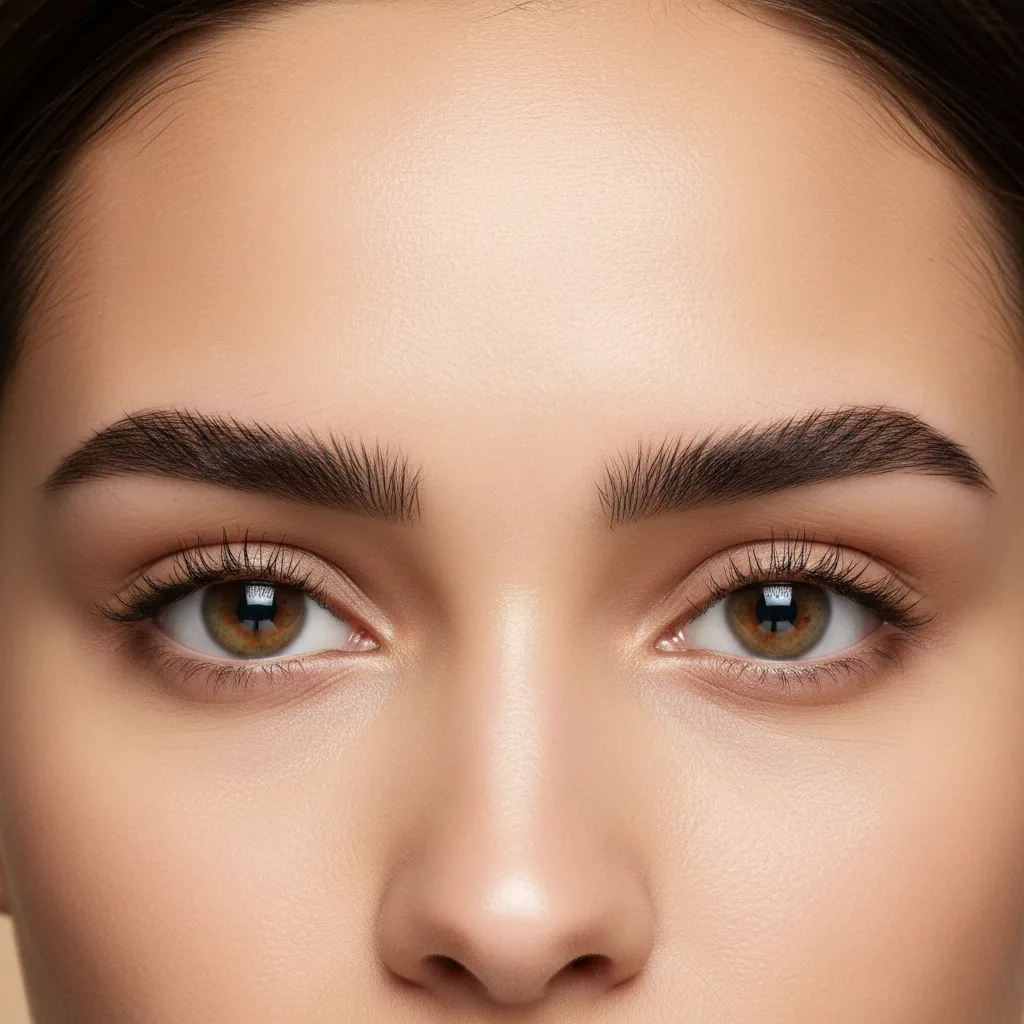
Defined by a minimal arch, straight eyebrows run almost horizontally from the head to the tail. Although it is one of the most requested shapes, it is also the easiest to get wrong by creating a heavy, flat block over the eyes. Here is how to tell if straight brows suit your facial proportions and what to ask your brow artist.
What Defines a Straight Brow
A straight eyebrow is a shape where the line from head to tail runs almost horizontally. There is still a subtle rise, but it is gentle enough that the eye does not read it as a distinct arch. The peak is either nonexistent or shifted far toward the tail and barely noticeable.
Straight brows are frequently confused with thick, bushy brows. However, thickness refers to hair density, while shape describes the trajectory of the line. A straight brow can be delicate and slim, just as a thick brow can have a dramatic high arch.
Geometry: The Three Reference Points
Every brow relies on three key points: the head, the arch, and the tail. With a straight shape, the height difference between the head and the peak is less than one-third of the total brow width. If you place a straight edge along the lower border, it will sit almost flush with the line, whereas an arched brow leaves a clear gap underneath.
The tail does not need to sit strictly at the exact level of the head. It can slant slightly upward or downward—the shape remains straight as long as there is no prominent lift through the middle.
Who Suits Straight Brows
A straight brow acts as a strong horizontal line: it visually shortens the face and widens the upper third. This dictates how it interacts with different bone structures:
- Long, narrow faces benefit the most, as horizontal lines break up vertical length and balance proportions.
- High foreheads look more balanced because a straight brow reduces the visual space between the eyes and the hairline.
- Delicate, soft facial features remain harmonious because the absence of sharp angles prevents the brows from overpowering the face.
- Youthful faces with open, lifted outer corners of the eyes carry the shape best, as straight brows do not provide an optical eye lift.
Which shape does your face ask for?
Upload a photo: your facial proportions are measured, and the shape follows them rather than a trend.
Analyze my browsWho Should Avoid Them
On round and square face shapes, straight brows often add unnecessary width where vertical balance is needed, making the face look wider and heavier.
They are also unflattering on downturned eyes. Because a straight line does not lift the gaze, it can make downturned eyes appear droopy or tired. In this case, a soft arch or an ascending line works much better.
| Facial Feature | Straight Brow Effect |
|---|---|
| Long face | Flattering; visually shortens length |
| Round face | Unflattering; adds horizontal width |
| High forehead | Flattering; balances upper third |
| Downturned eyes | Unflattering; exaggerates tired look |
| Strong, sharp features | Use caution; keep the line softer and thinner |
What to Ask Your Brow Artist
Simply asking for "straight brows" often leads to an overly flat shape that takes months to grow out. Instead, give specific instructions:
- Preserve the lower baseline and refine the upper border. A straight shape is achieved by keeping density above the base, not by carving away the natural underside.
- Keep the tail intact. While straight brows have a shorter tail than arched shapes, trimming it off entirely leaves the brow looking abruptly chopped.
- Maintain proper length. The tail should still align along the line from the nostril through the outer corner of the eye. Going straight does not mean going short.
Three Common Mistakes to Watch For
A uniform block shape. If the brow remains the exact same width from front to tail, it overwhelms the face and creates a stern expression. A natural straight brow is about twice as wide at the head as at the tail, tapering gradually.
Placing the brow too low. A horizontal brow positioned too close to the eye presses down on the eyelid. The space between the crease and the lower edge of the brow should never be narrower than the brow itself.
A harsh, stamped front. Filling in the head of the brow with hard, 90-degree corners looks unnatural. Even on a straight brow, the inner edge must remain soft and diffused.
Frequently Asked Questions
Are straight eyebrows exclusive to Asian facial types?
While straight brows naturally occur often in East Asian features and gained global popularity through K-beauty trends, they are not limited to any ethnicity. What matters is overall facial symmetry, proportions, and bone structure.
Can an arched brow be transformed into a straight brow?
To an extent. You cannot change your natural hair growth direction completely, but you can soften a high peak through strategic trimming and styling. Brushing the hairs outward and slightly upward with a setting gel straightens the line effectively without over-tweezing.
How can I test this shape before committing?
Draw it in first. Straight brows are easy to test with a brow pencil: lightly fill in the space above your arch to create a horizontal top line without touching tweezers. If your face looks heavier or tired, this shape is not the right fit for you.